Warhoons
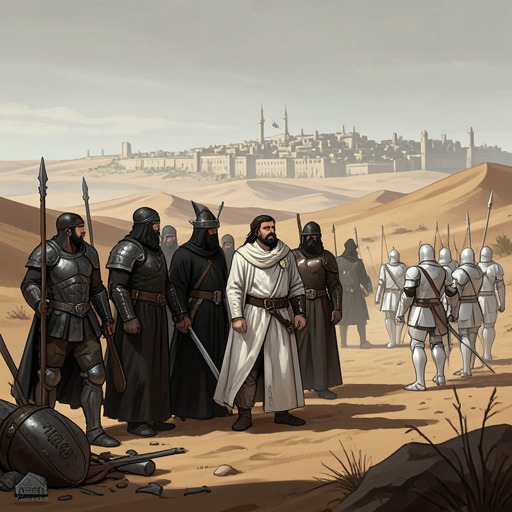
A Princess of MarsThe Warhoons are a Green Martian horde distinguished in John Carter’s account by frequent internal combat, severe customs, and a public culture of violent spectacle. Their rule is neither politically calm nor simply a matter of force: a comparatively young Jeddak is opposed by a jealous lieutenant, a title can pass through victory over a ruler, and great games make captives’ survival a public contest. As Carter encounters the horde first as a prisoner and later as an adversary, the Warhoons become one of the clearest examples of how Barsoom’s customs turn violence into both social order and entertainment.
Identity and Social Order
Carter describes the Warhoons as a smaller horde than the Tharks but more ferocious. He sees evidence of that reputation in the constant duels among their communities: during his time among them, he says, no day passed without deadly combat, and he witnessed as many as eight duels in one day. Violence is not an exceptional breakdown of their society but part of its ordinary rhythm.
Their political hierarchy is visible when Carter is brought before Bar Comas, the comparatively young Jeddak of the Warhoon hordes. The warrior who captured Carter, Dak Kova, is Bar Comas’s old lieutenant, yet he openly resents his superior. Dak Kova pointedly omits the customary greeting and presents Carter as a prospective opponent for a wild thoat at the great games, using the captive as an occasion to affront the ruler as well as a participant in the spectacle.
The conflict between ruler and lieutenant ends in a transfer of power. After the confrontation that leaves Bar Comas dead, Dak Kova’s females save Dak Kova from the same fate. Three days later, he walks to Bar Comas’s body, places his foot on the former ruler’s neck, and assumes the title of Jeddak. Bar Comas’s hands and head are taken as ornaments for the new ruler; the remainder of his body is cremated. The succession is thus represented through victory, public possession of the defeated ruler’s remains, and the immediate recognition of the victor’s title.
Captivity and the Great Games
Carter’s introduction to the Warhoons is part of a military expedition that has already been disrupted. Dak Kova’s injuries delay the march, and the horde abandons its raid on a small Thark community—a retaliatory expedition connected to the destruction of an incubator—until after the great games. The entire force, numbering ten thousand warriors, turns back toward Warhoon. The games therefore interrupt one campaign and redirect the horde toward a collective event at home.
After about three days’ march, Carter reaches the city and is confined in a dark dungeon, chained to its floor and walls. The account emphasizes the prolonged uncertainty of this imprisonment: food arrives at intervals, but Carter cannot tell whether he has been there days, weeks, or months. His jailer does not answer his questions. The prison isolates him not only physically but from any reliable measure of time or information about the world above.
The Warhoons eventually bring Carter and Kantos Kan out for the great games. Their amphitheater has been excavated below ground and is large enough, in its present condition, to hold the twenty thousand assembled Warhoons. Debris partly fills the old structure; stones from ruined buildings form barriers around the uneven arena, and cages at either end hold captives and animals until their turns. Carter and Kantos Kan are placed together in one cage, alongside wild animals, Green Martian warriors, and women captured from other hordes. The scale and arrangement make the games a communal spectacle built around the confinement of possible victims.
Near the end of the contests, only Carter, Kantos Kan, and a towering Green Martian warrior remain. The two others are to fight first; the survivor is then to face Carter for the liberty granted to the final victor. Kantos Kan has already fought several times and won, at points by only a narrow margin. His next opponent is nearly sixteen feet tall, while Kantos Kan stands just under six feet. Kantos Kan wins by throwing his sword from a distance of about twenty feet, killing his opponent and leaving Carter to face him for the promised freedom.
Carter and Kantos Kan refuse to turn the last contest into a real fight. They prolong it toward darkness, while the crowd grows angry at their failure to deliver a fatal blow. Carter then stages his own defeat: Kantos Kan places the sword so that it appears to pierce Carter, then performs the expected final stroke without killing him. In the gathering dark, the spectators cannot tell that Carter survives. He tells Kantos Kan to claim his freedom and search for him in the hills east of the city, and Kantos Kan leaves the arena. The games’ rules create a narrow opening for escape, but only because the two prisoners cooperate against the spectacle’s demand that one kill the other.
War and Political Consequences
The Warhoons’ internal violence is matched by their capacity for organized warfare. In a later battle against the Tharks, ten thousand warriors engage on the field. Neither side gives nor asks for quarter, and neither attempts to take prisoners. Three thousand lie dead afterward. The remnant of the Warhoon horde retreats to its thoats as the battle turns, ending the immediate confrontation without a negotiated settlement.
The battle also places individual relationships beside the horde’s collective hostility. Carter fights shoulder to shoulder with Tars Tarkas through the long afternoon, and Tars Tarkas’s brief acknowledgment of Carter’s efforts gives the scene a personal counterpoint to the mass conflict. The episode does not make the Warhoons less formidable; instead, it shows the cost of the same uncompromising martial order that governs their duels and games.
The wider campaign against the Warhoons belongs to a larger search for Dejah Thoris. Two Green Martian communities have already been destroyed by avenging fleets, but no trace of her has been found; the search has only recently extended southward. Kantos Kan, exploring Warhoon territory alone, spends two days and nights searching its quarters and dungeons for the princess before being captured as he tries to leave. The Warhoons thus enter the plot both as a self-governing horde and as a danger encountered amid the pursuit of a missing captive.
Customs, Scarcity, and Significance
Carter’s account links Warhoon behavior to a broader Martian culture in which violent death is common and life is held lightly. He estimates that only about one Martian in a thousand dies of sickness or disease, while many deaths result from duels, hunting, aviation, and war; childhood mortality, including deaths caused by the great white apes, is also substantial. The text connects this pattern to Barsoom’s waning resources and to social practices that continually expose individuals to danger. This context helps explain the frequency of Warhoon violence without reducing each act to a single motive or treating custom as an excuse.
The contrast between the Red Martian scientific expedition and Green Martian hostility further situates the horde within Barsoom’s political divisions. Dejah Thoris explains that her expedition was peaceful and concerned with charting air currents and measuring atmospheric density, work that she says serves the planet’s survival. She appeals to the Green Martians to live in amity and cooperate with the Red Martians. Her appeal exposes the stakes beneath the conflict: a planet dependent on shared systems of air and water is also divided by communities that raid, retaliate, and pursue one another through war.
The Warhoons’ role in the narrative is therefore more than that of an enemy force. Their dungeon and arena turn imprisonment into a test of endurance and cooperation; their games make public violence a social institution; their succession custom shows how personal rivalry can remake political authority; and their battlefield retreat measures the cost of a conflict in thousands of lives. Against these structures, the prisoners’ refusal to kill each other and the later companionship formed in captivity offer a limited but consequential alternative to the horde’s governing logic.